
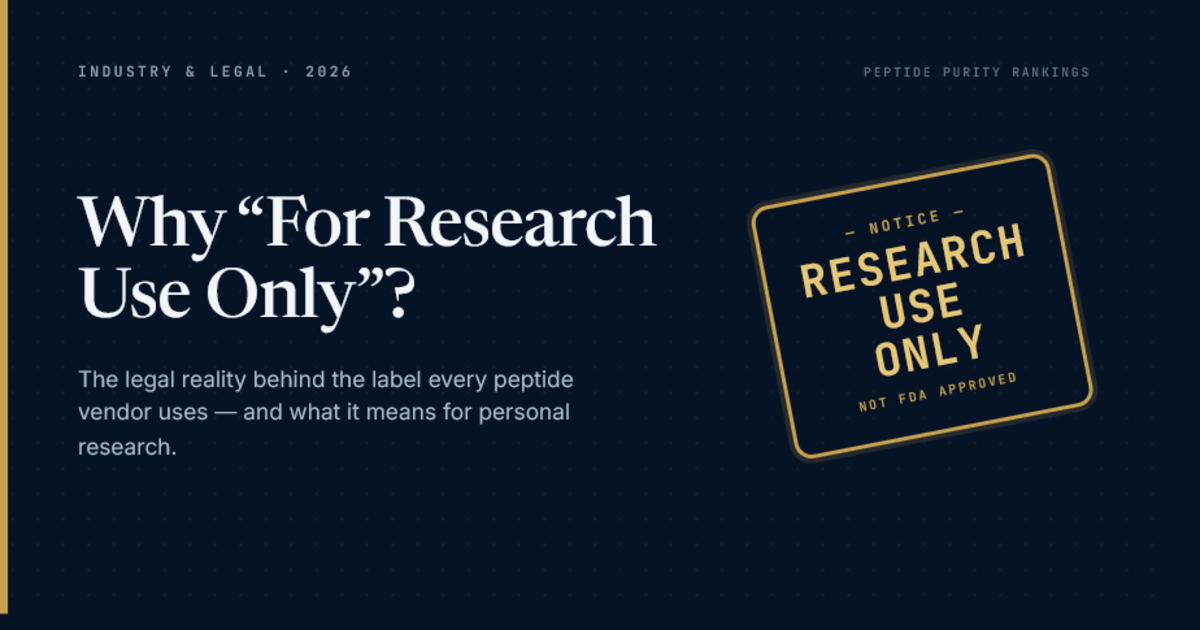

Peptide Legal Landscape 2026: Why “For Research Use Only” Matters — and What It Means for Personal Use
Most peptides are sold strictly for research. Here’s the current legal reality, why every legitimate vendor uses the disclaimer, and what people doing personal research should actually know.
 Harrison Peralta · Updated Jul 2026 · 8 min read
- The vast majority of research peptides — including popular ones like BPC-157 and TB-500 — are not FDA-approved for human use, which is why every legitimate vendor labels them “For Research Use Only.”
- That language exists primarily for legal protection. It keeps vendors compliant and makes clear these are not approved medications — it does not stop people from using them for personal healing.
- Personal use exists in a genuine legal gray area. Enforcement has historically targeted manufacturers and large sellers, not individual users — but personal use is not legally protected, and sourcing quality matters more than ever.
What does “For Research Use Only” actually mean?
The FDA regulates drugs and substances intended for human consumption. Most research peptides have not gone through the full approval process. By labeling products “For Research Use Only,” vendors stay on the right side of regulations that would otherwise classify their products as unapproved drugs.
This disclaimer is standard industry practice and is required for vendors to operate openly in the United States. It is a compliance statement first — not a comment on whether a compound “works.”
The “Research Use Only” language serves two purposes: it keeps vendors legally compliant, and it makes clear these are not FDA-approved medications. That clarity encourages people to do their own due diligence rather than treating research peptides like prescription drugs.
What is the current legal reality in 2026?
As of 2026, the framework can be summarized in four points:
- Most peptides remain unapproved for human therapeutic use.
- They can be legally purchased for laboratory and research purposes.
- Using them for personal healing, performance, or medical reasons technically falls outside FDA-approved use.
- Enforcement has historically focused on manufacturers and large-scale sellers rather than individual users.
This creates a situation where many people are effectively conducting their own “research” on themselves, even though the products are not sold for that purpose.
What should personal researchers understand?
A growing number of people use research peptides for real-world applications — injury recovery, gut health, inflammation, and general wellness. While many report positive experiences, this approach comes with important considerations:
- Purity and quality risks — without proper testing, you have no guarantee of what you’re actually getting.
- Limited long-term human safety data — many peptides have strong preclinical research but few large-scale human trials.
- Legal considerations — while personal use is rarely prosecuted, it is not legally protected.
- Sourcing matters more than ever — in this environment, vendors with strong third-party testing become critical.
Practical advice for personal research
If you’re exploring peptides for personal use, here are realistic steps many people take:
- Prioritize vendors with recent, batch-specific third-party COAs.
- Start with well-documented compounds that have more research behind them (such as BPC-157 and TB-500).
- Keep detailed records of what you’re using and how you respond.
- Understand that you are operating outside of conventional medical guidance.
For a data-driven view of who tests transparently, see our current vendor rankings → and our guide on how to choose a quality peptide vendor →
Critical disclaimer & safety notes
This article is for educational purposes only and does not constitute legal or medical advice. Most research peptides are not FDA-approved for human use. Using them for personal healing exists in a legal gray area and carries potential health and legal risks. Always consult a qualified healthcare professional.
Bottom line
The current legal framework requires vendors to sell peptides strictly for research. That doesn’t stop people from using them for personal healing — and many continue to do so. But this approach demands a high level of personal responsibility, especially around sourcing and quality verification. Understanding the legal landscape helps you make informed decisions rather than operating on false assumptions.
How to Choose a Peptide Vendor: Why Third-Party Testing and Batch Tracing Are Non-Negotiable
Not all peptide vendors are equal. Here’s exactly what to look for when choosing where to source research peptides — and why independent COAs and batch matching decide everything.
Harrison Peralta · Updated Jul 2026 · 7 min read
- Price is often the worst indicator of quality. What actually matters is verifiable third-party testing, batch traceability, and transparency.
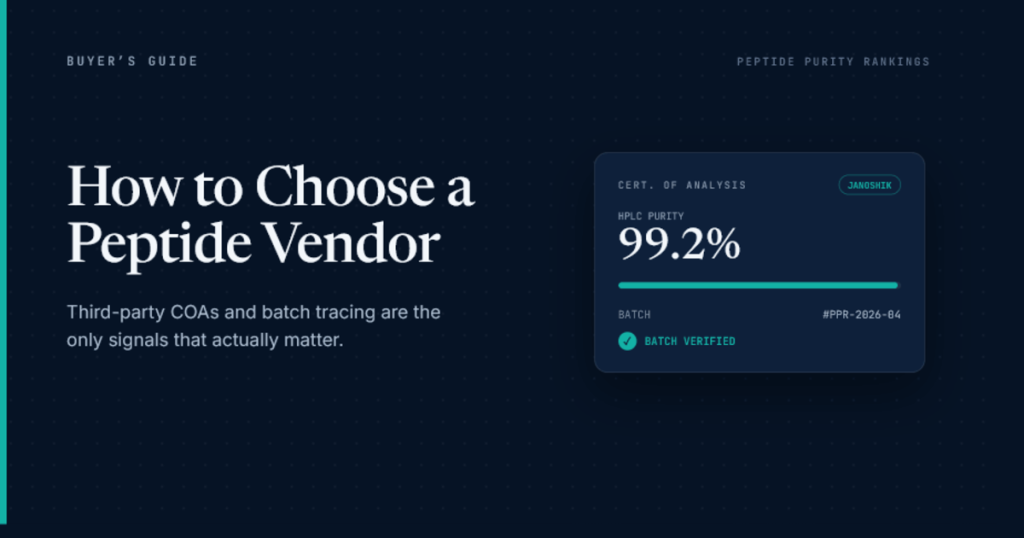
- A proper Certificate of Analysis (COA) shows HPLC purity, mass-spec identity confirmation, and a batch number that matches the vial you receive — from a named lab such as Janoshik.
- If a vendor cannot provide a recent, batch-specific COA you can verify on the lab’s own website, that is a major red flag — regardless of marketing or price.
Why is third-party testing so critical?
Many vendors claim their peptides are “99% pure,” but these claims are meaningless without independent verification. Reputable vendors send every batch to a third-party laboratory (such as Janoshik) for testing.
HPLC purity results · mass spectrometry confirmation of identity · and the specific batch number that matches the vial you receive. If any of these are missing, treat the report as incomplete.
Why does batch tracing matter?
Even if a vendor has good testing on some batches, that doesn’t mean every batch they sell has been tested. This is why batch matching is so important. A trustworthy vendor will:
- Print the batch number clearly on the vial.
- Provide a COA that references that exact batch number.
- Allow you to verify the report directly on the testing lab’s website.
This traceability protects you from receiving an untested or lower-quality batch sold under the same product name.
Red flags when choosing a vendor
| Warning sign | What it usually means |
|---|---|
| Prices far below everyone else | Poor quality or no real testing |
| Generic or recycled COAs | Report doesn’t match your batch |
| No named testing lab | Unverifiable results |
| “Limited stock” pressure tactics | Marketing over substance |
| Poor communication on docs | Documentation likely doesn’t exist |
How to evaluate a vendor properly
Before ordering, ask yourself these four questions:
- Can they provide a recent COA for the specific batch I’m buying?
- Is the testing lab named and verifiable?
- Do they make it easy to match the batch number on the vial to the report?
- How long have they operated with consistent feedback?
For a data-driven overview of how current suppliers perform on testing and transparency, review our current vendor rankings → and full ranking methodology →
Why this matters for popular peptides
Whether you’re looking into compounds like BPC-157 or TB-500, the quality of the material you receive directly affects any research you’re doing. Poor purity or incorrect identity can waste time and money — and in some cases create unnecessary risk. That’s why we emphasize testing so heavily across every peptide profile.
For laboratory research and educational purposes only. Research peptides are not FDA-approved for human therapeutic use. Nothing here is medical or human-use guidance. Always verify batch-matched, recent COAs from named labs before sourcing.
Bottom line
The best peptide vendors make third-party testing and batch traceability easy to verify. Cheap prices and flashy marketing mean very little without proper documentation. Taking the time to check COAs and batch numbers is one of the most effective ways to protect the integrity of your research.

Harrison Peralta is a serial entrepreneur and investor with several successful startup exits, and a dedicated researcher and biohacker who turns dense laboratory data into decisions anyone can act on. Before building companies of his own, he held leadership roles at Amazon, Microsoft, and KPMG.
More reading
Keep going
The independent standard for evaluating research peptide vendors — ranked on verified lab testing, transparency, and quality.
Content is provided for research and informational purposes only. Products are evaluated for laboratory research use; the site offers no medical, dosing, or human-use advice. Not for human consumption.
© 2026 · v1.0